Too Much Fiber in Dairy Foods Is Not a Good Idea
|
|
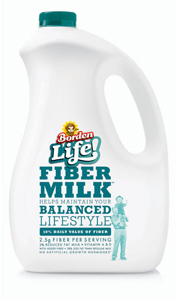
An 8-ounce-serving of new Borden Life! Fiber Milk contains 2.5 grams of fiber, making it a good source of this nutrient lacking in most diets.
|
Two years ago on a wintry morning, my eldest son, then in fourth grade, woke up early and asked if I would make him pancakes. This was music to my ears so I did not even think twice about using the only box of pancake mix in the house: a sample of a new high-fiber product. Following the box directions, I made about two servings, figuring I would join him for a warm breakfast.
Well, like most mornings, as the countdown to getting everyone out the door advanced, I got distracted, and he ate ALL the pancakes. That’s right, 10-plus grams of inulin entered an 80-pound boy within a 10-minute time frame.
Don’t worry. I e-mailed the teachers, explained the situation, and asked that they don’t make him wait if he requests a hall pass for the bathroom. That day, my son made many trips to the boys’ room as a result of consuming too much fiber in a short period of time.
Because foods are enriched on a per-servings basis, and what FDA says constitutes a serving is not an accurate portion for most Americans, product developers must consider a realistic portion when fortifying with ingredients that can make sudden impacts.
Most dairy foods are an ideal delivery vehicle for fiber enrichment because they are consumed in reasonable portions. For example, almost all yogurts are packaged as a single serving. Frozen novelties are, too. With fluid milk, one cup is a reasonable serving size. And even if someone drinks a pint of new Borden Life! Fiber Milk from the Borden Dairy Co., Dallas, he or she will consume only 5 grams of chicory root (inulin), an amount that can be tolerated by most individuals.
According to “Fiber Food Ingredients in the U.S.: Soluble, Insoluble and Digestive-Resistant Types,” which was published in June 2010 by MarketResearch.com Inc., Rockville, Md., fiber food ingredients historically have been added to food formulations as performance ingredients. This is even true in the dairy category, where microcrystalline cellulose is used as an anti-caking agent on shredded cheese.
“Interest in boosting a food’s fiber content, and possibly making a health, nutrient content or structure/function claim is a 21st-century phenomenon,” says David Sprinkle, research director. “Not surprising, grain-based foods such as bars, breads, cereals and muffins, are the No. 1 category of new products making any type of package fiber claim, as grains are an inherent source of fiber. No. 2 is the combined category of snacks and desserts, many of which are grain-based, such as chips, cookies and crackers. Beverages and dairy foods follow.
“Since the first report was published, many fiber-enriched dairy products have entered the marketplace. And in general, fiber-enriched foods have become mainstays in supermarkets,” Sprinkle adds. (Check out two new items on pages 53 to 54.) “This is why we are updating the report to include market share by product categories. And our preliminary analysis shows that fiber-enriched dairy-based foods, including nutritional beverages and frozen novelties, are thriving in the marketplace.”
When it comes to enriching dairy foods with fiber, formulators will typically source soluble fiber ingredients, as most can be added invisibly to dairy products. Soluble fibers are best described as being soluble in water, with the most common examples being beta-glucan, fructo-oligosaccharides (FOS), galacto-oligosaccharides (GOS), gums, inulin, pectin, polydextrose, psyllium, some hemicelluloses and resistant maltodextrin.
Some soluble fibers absorb water and, in doing so, form a viscous solution or gel. They have the ability to trap dietary cholesterol and bile acids when passing through the gastrointestinal tract, helping the body eliminate cholesterol and reduce blood cholesterol levels. This viscous solution has also been shown to trap carbohydrates, slowing their digestion and absorption. This may help prevent wide swings in blood sugar levels during the day, as well as have an impact on the development of adult-onset diabetes.
These fibers have been successfully used in dairy foods, but it is the soluble fibers such as inulin, FOS and GOS that do not produce viscous solutions that seem to be used more frequently, as they can be added in significant amounts without being detected by the consumer. Further, many non-viscous fibers have been shown to boost calcium absorption and are fermentable, thus acting as prebiotics to promote the growth of beneficial intestinal bacteria known as probiotics.
Insoluble fibers, as the name suggests, are not soluble in water. They also do not form viscous solutions. The most common insoluble fiber food ingredients are lignin, cellulose and some hemicelluloses. Insoluble fibers are associated with reducing the risk of digestive disorders and certain cancers, as well as preventing or alleviating constipation.
Without a doubt, boosting the fiber content of common foods is a great way to help Americans get more of this very important nutrient that is said to be deficient in most diets. But it’s important that intake be spread out during the course of the day. Just ask my son.
Looking for a reprint of this article?
From high-res PDFs to custom plaques, order your copy today!