Packaging Technology: Pushing the Line
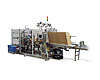
Dairy processors are under the gun to crank out a wider variety of products at a faster rate. That means every system on the plant floor has to keep up the pace and operate reliably time after time as various carton sizes and multipacks, whether sleeved or unsleeved, in cases and crates, move along the line.
“The days of dedicated lines producing one product size in perhaps a couple case counts are over,” remarks Tim Howell, food packaging division sales manager at Morganville, N.J.-based Oystar USA.
A crucial link in that chain is secondary or end-of-line packaging, often a dairy food product’s last stop between the filler and the shipping dock.
“As processing speeds continue to increase, packaging speeds have had to keep pace. You never want your bottleneck to be downstream in your production process, so as the processing speeds creep up, we need to continually look for ways to meet or exceed them,” says John French, director of sales and marketing for The BluePrint Group, Colonial Heights, Va. “Things like flexibility and fast changeover are now being taken as a given. Our multi-axis robotic systems and vision-guided systems are gaining more and more of a foothold over simple mechanical case packers.”
Luciano Gandossi, key account manager for Cermex Inc., part of the Norcross, Ga.-based Sidel Group, agrees flexibility is helping drive development of secondary packaging systems, as is a need for an intuitive machine-operator relationship. “Today’s operators grew up using iPods; their relationship to the machine cannot be less intuitive,” he says. “An operator should not need a manual to know how to run or troubleshoot a piece of equipment.”
Meanwhile, sustainability is not leaving the realm of plant operations anytime soon; Gandossi calls it “the centerpiece and main driver” of product development. For secondary packaging, sustainability means saving energy as well as reducing packaging material – for example, going from a wraparound case to a tray, says Jackie Caron, marketing services manager at Alexandria, Minn.-based Douglas Machine Inc.
Going green is helping drive the move toward shelf-ready packaging, which uses less cardboard. “Most companies are investigating alternatives to fiberboard material as one of the ways to reduce overall costs,” says Ken Sullivan, director of marketing at Delkor Systems Inc., Circle Pines, Minn. “In the past, a critical determinant has been a simple reduction in the measurable volume of materials consumed for secondary packaging. New metrics are now in play. Greenhouse gas emissions and energy consumption, particularly transportation-related, that go into the production of secondary packaging materials are now causes of concern.”
French says his company’s equipment is designed with energy conservation in mind. “Pneumatics, which for some manufacturers are prevalent on their machines, take considerable plant air. This is generated through electricity-hogging compressors in most cases,” he says. “We do not simply replace pneumatics with motors, which would drive up cost and is not totally following the mantra of lowering energy consumption. We instead innovate with simpler ways to perform primary machine functions.”
Howell says the U.S. market is starting to see more interest in using open stackable and partition-style trays as the final shipper rather than the more traditional full wrap-around cases. “This is primarily due to the amount of corrugated material that can be saved by using the former. Europe has enjoyed these savings for a number of years now and we’re starting to see the beginning of this movement here,” he says.
“Additionally, in Europe, solid-board multi-pack sleeve sets, featuring interlocking stacking corners that make them palletizable, are a recent development that eliminates the traditional corrugated final shipper altogether. The solid-board sleeve is glued and assembled in a way that provides superior product protection so it can be used as the final shipper.”
What’s out there
So processors need equipment that’s small, faster and more versatile, and consumes fewer resources toward an overall lower total cost of ownership. “All three of these primary needs are being met by technical innovation,” French says, noting that BluePrint aims to meet all these needs and more. “Another philosophy often overlooked is sanitary design. In this day and age of food contamination concerns, this is highly important, even in secondary packaging.”
Among its latest projects, BluePrint recently completed multiple lines using its Rainbow feeder module to feed a vision-guided robot to load cheese pouches into a meal kit assembly process for a major food company. “The Rainbow feeder took product from bulk, in large WIP containers that were produced in another facility, and brought order to the bulk mass, singulating the products out for the robot to complete the meal kit assembly process,” French explains. “Being in a raw food handling area, this was also a caustic washdown equipment installation.”
Cermex meets its customers’ needs “by centering our development around the key drivers, placing sustainability at the center of our product development plan and R&D effort,” Gandossi says. “Dairy packagers require efficient and reliable non-stop production in different types of environments. Our customers require simple existing-line integration along with custom solutions to fit their products. The specific characteristics of the products determine the type of packaging machinery.”
Among Cermex’s product innovations are shelf-ready/packaging-ready equipment, RSC/wraparound cases, a lean selection system allowing for efficient changeovers and robotic applications with automatic changeover solutions.
In addition to all the factors mentioned thus far, Sullivan says dairy industry customers “are driven by retailer mandates for labor efficiencies, shelf display capabilities and material recyclability/biodegradability. Fortunately for all, the Delkor Spot-Pak pad and overwrap style of secondary packaging has a proven track record of positive results in all these areas of concern.”
Douglas Machine offers a full range of case and tray packers through the Axiom line and sleevers with its Apex paperboard sleevers. Caron says Douglas’ equipment features intermittent and continuous motion and speeds of up to 85 cases per minute, with affordable washdown solutions and simple machine operation.
“The majority of the special need that we see is for a special sleeve design, pack pattern or count, or display shipper that is going to make a product stand out from the rest on the store shelf,” Howell says. “We address this by teaming our engineers with the customers, to develop unique packaging together that achieves the customers marketing goals and can be done in a realistic manufacturing environment.”
The newest and most significant innovation from Oystar, Howell says, is the SetLine Sleeving/Packing System, a multi-pack sleever and case/tray packer rolled into one hybrid framed system. “The SetLine system was developed as a solution to the flexibility limitations, large space requirements and poor line efficiencies related to a traditional downstream set-up that typically featured a continuous-motion multi-pack sleever linked to a separate case packing system with 20 to 30 feet of conveyor between them,” he explains.
Since its development three years ago, Oystar’s SetLine has only been actively marketed in Europe, which has seen a decline in the use of traditional stand-alone continuous-motion sleeving systems. “The SetLine system provides superior flexibility by allowing manufacturers to choose between multiple sleeve counts and styles, multiple case/tray shipper counts, styles and designs, and allowing for packing single unsleeved product with tool-less, no part changeovers in less than 20 minutes,” Howell says.
The future
What’s next on the horizon for secondary packaging systems? According to a recent survey on trends in secondary packaging by the Packaging Machinery Manufacturers Institute, the future means fewer materials along with new high-performance material innovations. That appears consistent with the top reason most companies gave for operations-driven improvements: cost savings (sustainability led the reasons for packaging-driven changes).
“Everyone will need to continue to innovate,” French says. “BluePrint is looking to add more functions to our system solutions, such as innovative product inspection capabilities, multiple functions within a single packaging cell and continuing to drive out mechanical or pneumatic functions that require considerable energy and scheduled maintenance programs.”
For Howell, the future means smart case-packing systems that will combine state-of-the-art vision and robotic technology and eliminate the typical problem areas of traditional case packer in-feeds, such as guide rail adjustment, reciprocating diverters and product metering. “These systems will be free flowing with zero backpressure, and changeovers will be done with the touch of a button,” he says.
Further, complete end-of-line systems will share a common frame and be directly linked to the primary packaging systems. “These systems would eliminate the need for accumulation by using the newest advancements in servo and robotic technology where all systems would work harmoniously with one another,” Howell says, “creating a highly efficient, highly compact, complete packaging line.”
Gandossi says sustainability must be taken to the next level. “We are still in its infancy,” he says. “This point will define who is in and who is not.”
Extras
BluePrint Group www.blueprintautomation.com
Cermex Inc. www.cermexinc.com
Delkor Systems Inc. www.delkorsystems.com
Douglas Machine Inc. www.douglas-machine.com
Oystar USA www.oystarusa.com
Looking for a reprint of this article?
From high-res PDFs to custom plaques, order your copy today!