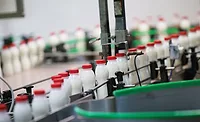
Keeping It Moving

Keeping It Moving
by Lynn Petrak
Conveyors and belting systems are designed for speed,
versatility and sanitation.
As any plant operator can attest, keeping pace with modern business demands requires equipment that keeps pace with production capability.
In an environment where time is money and glitches are
liabilities, moving things along in a dairy processing facility often, and
to a greater extent, involves the use of conveyors. Conveyors and belting
have been fixtures in manufacturing facilities for years, but are now found
virtually from receiving to shipping, from traditional systems to tabletop
models to integrated systems that perform a host of other functions.
Reflecting their increased usage, the latest conveyor
and belting equipment is engineered for the typical dairy demands of speed,
versatility, reliability and sanitation. In a dairy plant that moves
hundreds of products by the minute, with changeover for product and safety
purposes, conveyors become the circulatory system, so to speak, of the body
of production.
“Filling lines are getting faster and that
drives your packaging requirements too,” confirms Fred Beer,
president of The Deam Co., an Ontario-based manufacturer that recently
merged with Westfalia Technologies Inc. of York, Pa. Beer says automated
systems that are quick, rugged and designed for often-harsh settings like
dairies also help cut down on labor to eliminate manual transport, handling
and extra steps in washdown.
Those that build conveyors and fabricate belting
systems for installation in dairy facilities continue to tweak their
equipment to meet processors’ needs. Given the fact that conveyors
have been used in automated sites for decades and have a fairly long life
span, up to 15 or 20 years, the upgrades are often a next-generation
refinement in technology, an expansion in application or an integration of
capability with other types of equipment.
Clean and Simple
Some conveyor upgrades are done to help dairies keep
their lines running as safe as possible and to meet today’s stringent
requirements. Such conveyors feature easy disassembly and reassembly and
are constructed for effective sanitizing and washdown.
According to Beer, Deam (now known as the Deam Systems
division of Westfalia; Beer will lead the division) recently offered
something new to the marketplace. “One new style we’ve done in
the past year is one with an interlocked style that meets FDA-standard
designs for handling packaged or raw products,” he says. “We
did it specifically for a dairy running a clean room.”
In addition to its newest addition, Beer says that
Deam’s conveyors are being used in new ways in dairy plants.
“In dairy coolers, they’ve gone to different rack styles,
versus conventional drag chain, to reduce manual labor,” he observes.
Belting, too, is increasingly designed for sanitation,
especially with FDA and USDA standards for dairy plants, including 3-A
facilities. For example, Dallas-based Volta Belting Technology Ltd., which
offers homogenous conveyor belts for dairy and other food processing
facilities, regularly upgrades its belts to be durable and easy to clean.
In addition to its flat belts approved for use in federally inspected 3-A
dairy plants, Volta offers dairy manufacturers its SuperDrive®, a
hygienic positive drive conveyor belt. Its material and structure
eliminates crevices where bacteria can grow, and the integral teeth mesh
with the teeth on the drive pulley for a smooth conveyor belt drive.
Rolling with the Changes
Modern conveyor designs also reflect changes within
the dairy industry, as processors seek greater versatility in their
machines to complement their diverse product lines and production and
storagemethods.
For instance, conveyor and belting suppliers have
added new models to their lines that are equipped to handle plastic bottles
instead of traditional cartons. Dairy Conveyor Corp., Brewster N.Y., has
added a vacuum conveyor to its line that uses a vacuum to hold bottles to
the conveyor to prevent tipping.
Likewise, the Versa Container handling system from
Rosemont, Minn.-based Cannon Equipment Co. was developed as dairy
processors began to use more bottles for fluid milk.
Versatility, along with speed and sanitation, was a
factor in the design for the new Model 1510 autoload infeed and discharge
conveyor developed by Sheboygan, Wis.-based General Machinery Corp. The
1510 conveyor, used during the wrapping of cheeses, is built on a stainless
tubular frame and is made in different widths and lengths to suit a
manufacturer’s requirements and is equipped with a variable speed
drive system. According to spokesperson Marsha Binversie, the new model is
also able to handle the range of packages and sizes now offered by cheese
manufacturers. “Exact weights are becoming the norm on cheese
portions,” she says.
Span Tech, Glasgow, Ky., offers the HO-Series
Horizontal Offset Conveyor as part of its WhisperTrax™ modular
flexible conveyor line. The compound-curving nature of the conveyor allows
customers to accomplish multiple curves with one conveyor.
Combo Deals
Conveyors have long been used as part of a system in a
plant, teamed up and timed with fillers, cappers, wrappers and other
automated machines. These days, they are integrated in new ways and as part
of bigger systems.
Delkor Systems Inc., Circle Pines, Minn., for
instance, supplies spot packaging and tray packaging system that feature
conveyors and belt systems at key transfer points. To meet manufacturer
demands for versatility and efficiency, Delkor provides features like
in-feed systems for multi-pack laning.
Another innovative new system incorporating conveyors
comes from Toronto-based A.T.S. Engineering. The Canadian firm supplies
bulk filling lines with built-in conveyors, among other system.
“It’s a whole new style of machine, an all in one machine using
conveyors with a pail filler before the conveyor, a pail de-nester that
kicks onto an indexing tabletop belting conveyor, which is next to a
filling station. It’s a bulk filling system for cream cheese, cottage
cheese, sour cream, cream cheese and things like that,” explains
Anthony Subryan, chief executive officer and general manager, adding that
the system is equipped with a PLC screen for easy use and consistency and
flexibility in filling. After weighing, Subryan says, the product goes into
a shuttle-type lidding mechanism, where a lid is placed on the pail through
a conveyor with friction belting.
“It came out a bit ago, but we are really
getting into the dairy industry,” he says of the bulk filling system,
adding that much of the interest stems from processors’ desire to
reduce or redirect labor while ensuring accuracy. “It eliminates
people from the line and takes away errors because it is all automatic.
Someone just loads it up and stands back.”
Warehouse Solutions
Another trend in conveyors and belting in the dairy
industry is the increased used of such systems on the back end of the
business, for case handling and storage. Many conveyor companies offer box
and pallet conveyors for manufacturers again looking to use automation for
labor and efficiency purposes.
Dairy Conveyor Corp., for instance, offers a range of
systems for such usage and recently developed a conveyor for corrugated
containers that are becoming more common in plants. Last year, another
tabletop and cable conveyor company, Bloomsburg, Pa.-based Dyco Inc.,
developed an accumulating conveyor that can be used to handle both
containers and bottles.
Lynn Petrak is a freelance journalist based in the
Chicago area.
Looking for a reprint of this article?
From high-res PDFs to custom plaques, order your copy today!