I, Foodbot
While food and beverage applications represent a small part of industrial robotics, suppliers acknowledge they constitute one of the fastest growing segments. One of the earliest food uses occurred in 1985, when a Canadian plant of confectioner Rowntree Macintosh deployed a unit to transfer candies from molding to a wrapping line. High costs and reliability issues slowed the adoption of robotics to additional factory tasks, and many obstacles-product variability, gentle handling, equipment cleanability and sanitation-had to be addressed before technology developed for discreet manufacturing could be transferred to food. Those issues are being resolved, and high-speed robotic arms and vision-guided systems are beginning to work alongside and-in many cases-instead of humans in food factories.
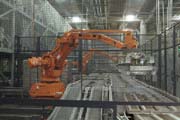
To be sure, the vast majority of robots are found in the packaging area, with secondary functions such as case packing and palletizing dominating. Material handling robots are beginning to generate ho-hum reactions, though an articulated arm robot still draws crowds at tradeshows. Prodded by auto manufacturers who want the flexibility to pick-and-place engine blocks and other heavy objects, today's articulated arm robots can handle 600 pounds or more in a graceful, sweeping motion. Even with club packs, few food products approach those payload demands, but the machines' flexibility and cost-effectiveness in even moderate-volume palletizing tasks give them great appeal.

A mechanical system would cost more and require at least 50% more floor space, estimates Schneider's Izzat Hammad, but a more important distinction is the system's ability to handle multiple products and shapes. "Because of the flexibility in changeovers and the elimination of long accumulating conveyors behind the robot, we see tremendous potential in food and beverage," says Hammad.
Articulated arm units are cannibalizing the market for gantry-style robots, an earlier version of palletizing robots that still enjoy popularity in distribution centers where mixed pallet loads must be assembled to meet the demands of each customer. "Robots are certainly taking the place of gantries," laments Earl Wohlrab, manager of Alvey Systems Inc.'s palletizing division. "Whether it's true or not, they're seen as taking less space than gantries." His firm integrates both types of palletizers, and he believes gantries "will definitely continue to shrink as a weapon in the arsenal."
"Packaging is probably the fastest growing market for robotics," seconds Mike Crane of the packaging robotics division of ABB Inc., in Auburn Hills, Mich. "We expected a 30% increase per year, but we're well ahead of that in 2004 and will probably see 80% growth."
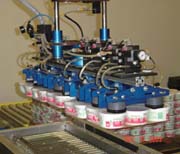
"The robots themselves have always been a non-issue in production integration," says Watson. "The challenges always have been issues like the discharge of the product, how it is presented to the robot and other external factors." Vastly improved vision systems, quantum increases in handling speeds and significant shrinkage of robots' footprints are among the most significant improvements in the technology in the last 17 years, he says.
Pepperidge continues to push the robotics envelope, most recently at its Bloomfield, Conn., facility, Food Engineering Magazine's 2004 Plant of the Year. A system employing a FANUC robot to palletize breadbaskets was recently installed at the plant, but it pales in comparison to an automatic pan-handling system that employs five ABB robots and constitutes "the heart of the productivity side" of advancements at the plant, according to Watson.
Unlike the mechanical pan-stacking, storage and retrieval systems used for years in commercial bakeries, the Bloomfield installation relies on articulated arms to gently handle an inventory of 26,000 pans. Nine workers were replaced and one-third the floor space was required compared to a retired plant. A smaller version of the system was installed three years ago at a Mrs. Baird's Bakery in Texas by Emtrol Inc., a now-defunct material-handling firm. As physically imposing as the robots are, the software and controls architecture that manages the system is the greatest advancement.
"The fewer decisions the robots had to make, the more reliable the system would be," explains Jeremy Kopicz, a former Emtrol engineer who helped execute the integration project with Lancaster, Pa.-based Genesys Controls Corp. The ABB robots came with their own controls and proprietary code. They also had DeviceNet cards, and that facilitated integration of the units with PLCs that also manage a dozen varieties of pans and operator inputs. "DeviceNet was critical for doing real-time control and physically controlling the robots, not just feeding them a profile," says Kopicz.
Big cheese to moldy fries
One of the most dramatic robotic installations in dairy is the AS/RS (automated storage and retrieval system) at Tillamook County Creamery Assoc., Tillamook, Ore. Designed by Westfalia Technologies Inc., York, Pa., Tillamook's 12-level cold storage facility has 15,000 pallet positions and is capable of holding 35 million lbs of cheese.At Wawa Dairy in Wawa, Pa., a sophisticated AS/RS system allows the dairy to serve as a distribution center for the parent companies chain of convenient stores. The fully automated system mixes a variety of products into mixed pallet orders for individual stores on a daily basis.
One of the most recent AS/RS installations is at HP Hood's expanded Winchester, Va. facility. The 10-level cold storage facility designed by HK Systems, utilizes automated VNA cranes.
Other dairy plants that use some level of storage automation or robotic palletizing include Ben & Jerry's facility in St. Albans, Vt., the cottage cheese line at Sinton Dairy, Colorado Springs, and The Country Fresh novelty plant in Toledo, Ohio, owned by Dean Foods.
To hold down costs, articulated arm robots typically are not equipped with sensor technology. The arms travel a preprogrammed path regardless of any obstructions, human or otherwise. OSHA began assessing fines two years ago for plants that failed to comply with the safety-circuit design guidelines and other aspects of ANSI/RIA 15.06-1999. The revised safety standards are designed to isolate the machines in restricted work zones.
Worker injuries are less likely if a machine is equipped with vision, and vision-guided robots are coming into their own. They also are expanding applications into the processing areas of food plants, adding increasingly sophisticated quality inspections to rapid-motion tasks. In recent years, major potato processors have experimented with vision as a quality check on French fries being conveyed from storage to packaging. Vision systems proved adept at spotting fries with mold, but removing them begged for a robotics solution that wasn't available. Collaborations between robotics and vision experts are intended to close the gap.
More often than not, collaboration depends on an integrator, and it is the integrator's decision on whose robot to use with which vision system. BluePrint Robotic Solutions in Boulder, Colo., recently designated Cognex Corp.'s In-Sight vision sensor as its system of choice for high-speed robotics. BluePrint also is an integrator for ABB, which no longer develops robotic solutions for non-automotive applications. BluePrint works primarily with Delta-style robots, the metallic spider arms used frequently for pick-and-place. ABB and SIG/Doboy are the primary suppliers of Delta parallel-axis robots.
ABB's Delta robots can pick up to 150 pieces per minute, and picking them off a moving conveyor and in a random orientation requires a vision system that not only processes images quickly but also judges distances. Cognex made the transition in 1997 from pixel-by-pixel comparison to geometric pattern matching, or 3-D imaging. According to BluePrint's Joe Crompton, director of software and controls, "even their base model can keep a robot supplied with well over 200 targets per minute.
"Food and beverage is one of the biggest segments in robotics vision," he adds, "and the potential is huge."
Faster processing speeds have resulted in a single camera serving four or more robots in some applications. Two years ago, a dedicated camera for each robot was the rule of thumb. Inconsistent lighting and surface finishes on packages still pose challenges, Crompton says, but today's systems are expanding their role in quality-assurance, particularly in the handling of raw foods such as frozen entrees. His firm recently designed a vision-guided, tray-loading robot that works in a freezer.
While working at TechniStar, Crompton helped integrate vision-guided robots on Pepperidge Farm's Milano cookie line in the late 1980s. Inspection functions were "rudimentary" at that time. "Now we're getting into recognizing shapes, whether product is broken or the right color, and it's done with vision systems that cost less," he says.
Adept Technology Inc. provided the vision-guided robots in the earliest Milano applications. "Compared to then, vision systems are probably five to ten times faster now, costs are down substantially and cycle rates are going up," reports John Dulchinos, general manager of the Livermore, Calif., firm's robotics division. With 3-D vision, overlapping cookies on a moving belt no longer pose a problem, he says. Speeds have more than doubled to 100 to 130 parts per minute.
Adept's SCARA (selective compliance assembly robot arm) robots are an alternative to Delta-style robots for high-speed picking. Though lacking the range and degrees of freedom, SCARA units boast compactness, fast acceleration and high-repetition accuracy. Precision is important in electronics and automotive assembly, though delicate food products like a 5 gram cookie are better served by a soft touch. When capping the two halves of cookies, the SCARA units sometimes are programmed to sandwich them slightly off center, "to make it look home-made," says Dulchinos. About 1,000 Adept robots are in service in food plants worldwide, he estimates, with frozen food, candy and bakery applications most prevalent. Handling baked goods as they exit an oven is a task especially well suited to a robot. Otis Spunkmeyer, for example, slashed product damage rates dramatically with a vision-equipped muffin tray-loading system.
A washdown-ready, IP67 certified robot for handling raw meat was developed in the early 1990s, but cost resulted in few sales, Dulchinos recalls. Suppliers continue to work on cleanable robots for heavy washdown environments, with modest success. FANUC has a system in Europe for butchering meat. "Will it be here in a year? No," says senior engineer Matt Job. "Will it be here in five to ten years? Definitely."
FANUC has two installations using a "robosuit," stainless-steel cladding to protect a robot that cuts pork bellies, Job says. "Everybody could make stainless-steel robots, but nobody could afford to buy them," he points out. FANUC hopes to engineer a system that eliminates crevices that can harbor bacteria, drains after washdown, meets 3A specifications for the gripping arm and uses food-grade lubricants. Processors also need to modify their practices, such as switching to less caustic chemicals and foams when cleaning and sanitizing the units.
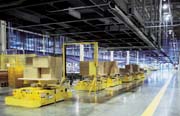
"Control logic has improved tremendously, allowing manufacturers to operate with fewer vehicles and, thererfore, at a lower cost," Kotecki adds. Users include Keebler, Coca-Cola and Miller Brewing.
Though suppliers have made vast improvements, durability and controls integration continue to be a drag on widespread use. Adept recently addressed the second issue with a servo architecture that uses a DF-1 serial connection on Allen-Bradley PLCs. It allows users to program and control the robots from the PLC with a minimum of wiring. While much slower than Ethernet, the connection simplifies start-up and changeover for most applications.
Durability is relative. "We have conventional palletizers out there that are 30 years old," notes Alvey's Wohlrab. "I just don't see the longevity of robots beyond 10 years."
Durability has not been an issue at Pepperidge Farm. Though units have been rebuilt and upgraded over the years, 18 SCARA arms with almost 60,000 hours of service continue to execute delicate procedures at the company's Willard, Ohio, plant, Watson reports.
ROI on that automation investment occurred long ago, and maintenance clearly hasn't been a stumbling block. "From a mechanical standpoint, there is nothing in a robot that is beyond what a food plant can handle," Adept's Dulchinos says. "The controls and software, on the other hand, may be quite different."
Given the state of automation throughout the food industry, controls and software maintenance are entering a comfort zone for many plant engineers. The real question is economics: have robot costs declined sufficiently to produce quick ROI compared to labor costs and repetitive-motion injury claims? At an increasing number of plants, they have. n
A version of this article appeared in Food Engineering Magazine.
Sidebar
Visionary robot-users in food
While food and beverage processors are only one part of the $280 million non-automotive robotics market, they represent one of the fastest-growing segments. And food processors increasingly are incorporating vision systems in their robots: food companies increased spending on vision systems 7% in a flat overall market last year, according to analyst Nello Zuech of Vision Systems International, and part of that spending was incorporated into $15 to $20 million worth of vision-guided robots.
The automotive industry continues to dominate in robotics automation. Ann Arbor, Mich.-based Robotic Industries Association (RIA) estimates two-thirds of robots still go into automotive applications, and the needs of those manufacturers are driving the technology. Arc- and spot-welding robots constitute 45% of all applications, with material handling representing another 37%. RIA estimates 135,000 robots are currently used in U.S. factories, second only to the Japanese industrial market.
For More Information:
ABB Inc.Mike Crane
262/785-3566
Adept Technology Inc.
John Dulchinos
408/432-0888
Alvey Systems Inc.
Earl Wohlrab
314/993-4700
BluePrint Robotics Solutions
Joe Crompton
303/581-9600
Cognex
John Lewis
508/650-3140
FANUC Robotics America Inc.
Matt Job
248/276-4123
Genesys Controls Corp.
Jeremy Kopicz
717/291-1116
HK Systems
Mike Kotecki
262/860-6769
Schneider Packaging Equipment Co.
Izzat Hammad
315/676-3035
Westfalia Technologies
Dan Labell
717/764-1115
Looking for a reprint of this article?
From high-res PDFs to custom plaques, order your copy today!