Aseptic in Winchester
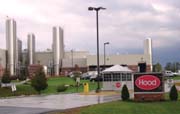
Winchester, the home of the late country music legend Patsy Cline, was chosen for its location and its workforce, as the site of what has become a cornerstone of Hood's metamorphosis from a venerable, but rusty regional leader, to one of the top national dairy companies. With the addition of an aseptic line, capable of producing flavored milk and other low-acid fluid products in single serve plastic bottles, this 400,000 sq ft plant continues to play a crucial role in Hood's future.
"Hood would not be the company it has become in the ESL world, were it not for Winchester," says John Kaneb, Hood's Chairman.
"The new installation at Winchester provides us with the opportunity to produce aseptic products in plastic bottles. It will certainly be employed for NesQuik, for Carb Countdown and probably for other products that have yet to surface."
During the past four years the Winchester plant has continued to grow as the plant's original design plans were fully implemented. With the first major addition completed, the plant now has five process systems feeding six individual fillers. It runs 7 days a week, and it processes in excess of 70 million gals per year.
Hood has invested "the better part of $200 million" in the plant which now employs around 350 people. The current expansion cost more than $40 million.
The new line features an 81-head aseptic rotary filler built in Japan by Shibuya Kogyo. It has the capability of filling up to 600 pint bottles per minute.
When Dairy Foods visited the Winchester site in mid-October more than a dozen technicians from Shibuya were onsite putting the finishing touches on the installation. Half of the plant's auditorium-like training room had been given over temporarily as a control center for the installation project.
"A good number of Hood people traveled to Japan earlier this year during the purchase and assembly," says Leigh Pehrson, Hood's director of ESL Operations. "Subsystems were assembled and tested in Japan before being disassembled and shipped here."
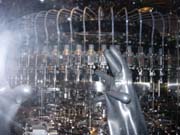
Pehrson, a long-time member of the Hood operations team, has been in Winchester for about two years. He says the process of expanding the plant and adding aseptic capabilities has been remarkable. The Shibuya filler itself is an amazing sight-a double deck of steel and glass. The exterior steel is as shiny as the chrome on a Harley Davidson, and the windows reveal lighted chambers with bright rotors and filling heads looking more like a jewelry store display case than a packaging machine.
The Shibuya system is similar to an installation at a Mott's juice plant in Aspers, Pa. but this is the first dairy application in the U.S. Shibuya has a U.S. office in Modesto, Calif.
Fast and simple
The filler is capable of running at blinding speeds."It's a high-speed rotary filler that can fill 600 bottles per minute using 16 oz bottles," says Lee Baker, dir. of engineering at Hood. "It uses a different sterilant than most rotary fillers, which is why we will be able to use it for aseptic."
Shibuya has been using aseptic- approved sterilant for some time in fillers it has designed for pharmaceutical and beverage markets worldwide. But this will be the first time such a system has been used for low acid products in the United States.
Baker gave Dairy Foods a brief description of how the filling system works:
Product is batched and then UHT (Ultra High Temperature) treated with a slightly modified version of a Tetra Pak VTIS direct injection steam system.
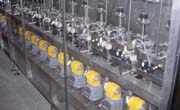
The blowmolded bottles are infed with a screw feeder and are then picked up by a series of rotors with neck grippers that transport the bottles through the sterilization filling and capping processes. The bottles are sprayed inside and out with heated sterilant then heated and sprayed with a sterile water rinse. The heat treatment activates the sterilent and dries the bottle.
The rotary filler uses net weight filling. Shibuya says the fill is accurate to less than half a gram.
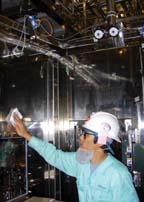
The hygienic filling chambers are sealed and are only accessible to operators through glove boxes, another indication of Shibuya's experience in pharmaceutical. Because they are conveyed with neck grippers, the bottles are less subject to jamming, but the glove boxes do allow the operator to make corrections when needed. The mechanics of the machine are accessible from outside the machine.
Sensors within the machine detect problem bottles and reject them before they are filled. Those chambers are run with a positive air pressure using sterilized air. For washdown, the piping and milk lines are CIP treated and the interior surfaces of the chambers are also treated with an automated washdown and sterilization system.
When the line is running at its full aseptic ability, Baker anticipates that production runs will easily exceed 24 hours. Shibuya's literature indicates that in some applications the system is capable of uninterrupted runs of up to 120 hours.
Supplier partnership
There are two other systems producing aseptic milk in plastic in the United States. Baker says Hood looked at those systems, but the Shibuya system offered more of what they wanted."The speed is the number one factor," Baker says, "We also have a high amount of confidence in Shibuya's abilities. But also, the other systems are only capable of aseptic with a foil seal.
"We have an existing ESL line that runs at 600 bottles per minute which requires us to punch out the foil and apply it to the bottle and seal it," Baker says. "It's a challenge that can lead to inefficiencies. With either system, when it is operating properly you get a great seal, but the straight cap system is simpler to operate and maintain than the foil."
While the Winchester installation is Shibuya's first dairy project in the United States, the company has installed 22 such systems in dairy facilities throughout the world.
Ken Saishio, president of Shibuya International, says the Hood installation is a milestone for his company.
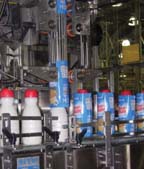
The system is expected to be running ESL product by the end of this month. The aseptic approval process is expected to be completed sometime around mid-2005.
"Shibuya is validating the machine themselves using an independent company to validate it," Baker says. That initial validation is simply to ensure that the machine is functioning properly. Once that is completed Hood will begin to run ESL product.
"Then Hood hires its own process authority to validate for aseptic, and
we file with FDA for a letter of non-objection."
Quality from front to back
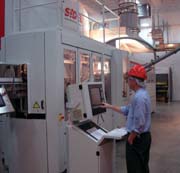
When its first-phase construction was completed in October 2000, the Winchester plant was already a model of a modern dairy plant. It featured two TetraPak VTIS steam injection systems and three ESL fillers. Now there are six lines. There were less than 150 employees, now there are 350.Milk and ingredients are brought to the plant through five receiving bays. Raw milk is stored in four silos with a total capacity of 240,000 gals. After the milk is pasteurized, ingredients are mixed in one of five batching systems. The product is then UHT treated with one of the VTIS systems before being sent to one of six fillers.
The product is heated to 175 degrees in a heat exchanger then pumped through a line where culinary steam is injected. This instantaneously raises the temperature to 280 degrees for two seconds. A vacuum tank is used to flash cool it to 175 degrees. And it is pumped back through the plate heat exchanger and cooled to 37 degrees.
The product is then sent to an aseptic surge tank from where it is forced by air pressure into the fillers.
The plant has two Evergreen gabletop fillers-an EH2 and an EH3 that are used for running half gals.
The plant also employs three Serac ESL fillers for plastic bottle filling. They are capable of running 12 oz to 96 oz bottle sizes. There are three Sidel blowmolders capable of producing PET bottles at rates of up to 44,500 bottles per hour.
The CIP system uses mix-proof valves, controlled by an Allen Bradley PLC control system.
Downstream of the fillers, the plant employs a number of secondary packaging machines for corrugated casing and palletizing. Fuji sleevers apply shrink sleeves to the bottles. Douglas case packers are used for tray packing and Alvey Palletizers are used to build pallets.
All palletizing is done in one of two cold storage areas, the second of which was added as part of the most recent expansion. The original warehouse uses a Very Narrow Aisle (VNA) system where manually-operated cranes guided by an in-floor wire system stack pallets six high. The new system uses automated cranes that are able to move product both horizontally and vertically and can stack pallets 10-high. HK Systems, Milwaukee, designed and installed the Automated Storage and Retrieval System or ASRS system.
Once aseptic capabilities are achieved, Hood plans to ship aseptic product directly to an offsite, ambient warehouse facility.
Plant Facts
Location: Winchester, Va.Built: 2000
Recent expansion: 2004
Square Foot: 400,000
Site: 80 acres
Total lines: 6
Employees: 350
Products: Lactaid, NesQuik, Coffee Mate, Carb Countdown
Hood Suppliers
Alfa LavalAlcoa Flexible Packaging
Allen Bradley
American Fuji Seal
APV-Invensys
TetraPak
Alvey
Blue Ridge Paper
BlackHawk Molding
Delkor Systems
Douglas
Evergreen Fillers
Feldmeier
Flavors From Florida
HK Systems
Johnson Truck Bodies
Serac
Sensient Flavors
Sidel
Shibuya
Terri Lynne
Walker Stainless
Looking for a reprint of this article?
From high-res PDFs to custom plaques, order your copy today!