Tools for Innovation: Dairy Foods for Today's Baby Boomers
In pursuit of the "Fountain of Youth," aging consumers today, more than ever before, are seeking foods and beverages that promise longevity, as well as health and wellness. Who are these aging consumers that aspire to lifestyles more similar to those of their children than their parents? It's the baby boomers, the generation who continuously defies the conventions of all previous generations and has no plans to exit the world without a good fight.
Baby boomers represent the largest group of consumers in the market today, and, in general, have a higher disposable income than any other demographic. This presents an opportunity for food and beverage manufacturers to formulate products that meet this group's needs and wants, as baby boomers are ready and willing to spend what it takes to retard any signs of aging.
Defining baby boomers
Baby boomers were born between 1946 and 1964, with many having parents who grew up during the Depression. For the most part, baby boomers have never truly experienced any financial woes themselves. Thus, it is baby boomers who are responsible for making it acceptable to pay more than $2.00 for a non-refillable cup of coffee. (Their parents frowned when the bottomless cup at the dime store counter jumped to 50 cents!)Compared to their parents, baby boomers are optimistic economically. They like to spend, and they like convenience and disposable items, which makes them a target for consumer goods manufacturers, including food and beverage marketers.
For example, when the first baby boomers were raising grade-school-aged children, they splurged on juice boxes for their kids' lunches, rather then being inconvenienced with filling a Thermos™. Even in mid-life, baby boomers seek conveniences to ease everyday life. After all, for this group, hectic lifestyles are the norm. In fact, when they have free time, they get busy, which is quite easy to do, as they are the first generation to dive into technology. Baby boomers think nothing of upgrading their laptops and mobile phones to the new model every other year.
In general, baby boomers are an individualistic generation with a focus on self and a tendency to reject authority. As they have since their teen years, American baby boomers are still shocking the nation. Mass political marches have given way to more intimate political demonstrations, ones that may involve flag waving, not flag burning. Many have taken to the courtroom in pursuit of their particular causes.
Baby boomers have unique beliefs and aspirations. As in the ‘60s and ‘70s, they still want to make the world a "better place" to live. (Peace!) And now, because they are getting older, they want to find a way to continue to be part of that better place. This is where their lifecycle change into mid-life is influencing the food and beverage industries, as baby boomers are seeking out dietary solutions to slow aging.
They cannot be ignored
During the 18-year span of baby boomer births, U.S. birth rates were at an all-time high. For example, in 1960, there were 23.7 births for every 1,000 people. Three years earlier in 1957, the rate was 25.3. Compare these figures to 1990, when the rate was 16.7, or more recently in 2000, when the rate was 14.7, and it helps explain how there can be an estimated 78 million baby boomers today, roughly 28% of the population.This very large and powerful demographic impacts the world in many ways. For example, new products thrive when marketers are able to woo this economic powerhouse. In fact, any trend that catches the attention of baby boomers changes the way the rest of the world functions. Indeed, baby boomers are shaping the food and beverage market at an unprecedented scale, thus, it is no coincidence that the popularity of functional foods continues to increase, as functional foods make many of the youth-enhancing promises baby boomers are looking for.
As baby boomers age, they confront the same standard chronic health problems that previous generations faced, but they are less willing to succumb. They believe they can control the aging process through diet and lifestyle changes.
"Millions of baby boomers are now beginning to experience chronic health issues," says Pamela Peeke, assistant clinical professor of medicine at the University of Maryland School of Medicine, Baltimore. "Boomer men are at higher risk for prostate cancer. Women in this age group are entering perimenopause and menopause. Both sexes are at increased risk for cardiovascular issues, such as high blood pressure and high cholesterol.
"Improving nutrition can address many of the chronic health conditions facing baby boomers. However, many important nutrients, for example soluble fiber, are not consumed in adequate amounts in typical American diets. In addition, many boomers have hectic lifestyles and say they don't have the time to pay attention to good nutrition," says Peeke.
While baby boomers find nutrient-enhanced foods appealing, it is important that these foods not make them feel "old." In fact, baby boomers will probably never consider themselves "old" or a "senior." Such terms describe their parents.
Foods specifically formulated for baby boomers must be marketed with subtlety. For example, Ensure® nutritional shakes carry the tagline: Complete, Balanced Nutrition® to help stay healthy, active and energetic.

Living healthier, longer
By 2020, U.S. Census projections indicate that more than one-third of the country will be over 50, while 25% of the population will be over 60. Amazingly, demographers predict that the number of people who will live past 85 years of age will increase five-fold by the year 2050.Why are people living longer? Much of it has to do with improvements in science, not only medical advancements, but also an understanding of the impact of diet and lifestyle choices on aging. Regarding diet, advancements in biotechnology and genomic analysis have enabled researchers to gain insight into the role of vitamins, minerals and nutrients in the diet and their specific functions in the human body.
For example, in the dairy category, emerging research indicates that cows milk is so much more than a nutrition-packed fluid beverage. Milk is a warehouse of structure-specific proteins, lipids and carbohydrates that may provide benefits beyond contributing to one's daily requirement for vitamins, minerals and macronutrients. When humans digest milk, these constituents are activated in different parts of the gastrointestinal system, providing the body with important physiological functions, many of which are exactly what the baby boomers are looking for.
Indeed, as consumers grow older, nourishment and pleasure are no longer the only reasons why they eat food, as health problems associated with the aging body require special nutritional needs.
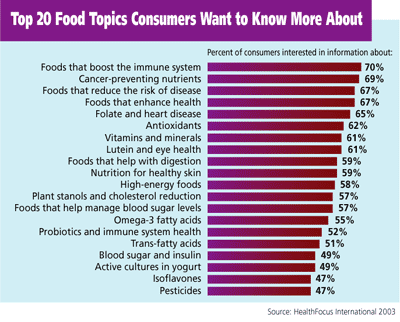
This past January at the Dairy Management Inc.™ Innovation Forum, Linda Gilbert, pres., HealthFocus International, Atlanta, addressed attendees with some enlightening insight, such as, "Baby boomers are the first generation of women to live with the long-term effects of menopause." She noted that foods formulated for women's health are becoming increasingly popular.
She also said that three out of four shoppers believe everyone has different nutritional needs. "Differing life stages, lifestyles and health conditions require customization/personalization to deliver ‘what is best for me,'" Gilbert said. "And consumers remain confident in their ability to manage their health. Nutritional solutions are believable to consumers. They often believe foods and nutrients can deliver benefits beyond basic nutrition, including health and wellness."
Many of these foods are categorized as "functional foods," and baby boomers are a driving force in their proliferation.
When it comes to America's obesity crisis, baby boomers have been the least resistant to stepping away from the plate to get back in shape.
What's encouraging for the dairy industry is that dairy has strong equity in health and wellness, and emerging science shows that dairy may play an important role in weight management. (See sidebar "Good News for Consumers...")
The whey to formulate for aging boomers
Manufacturers must consider many factors when formulating foods and beverages for baby boomers, particularly as this age group matures. For starters, aging tends to weaken the senses, which impacts smell and taste. Age-related losses are more noticeable in consumers on medication. Therefore, when formulating foods for this group, product developers should make an effort to enhance flavors and smells in order to ensure that they can be perceived by this consumer segment.Regarding packaging and graphics, visual acuity diminishes as well with aging, hence the need for larger and bolder printing on labels. Eye-catching, contrasting colors for flagged nutrition information help get a product noticed. User-friendly packaging with easy opening and closing features is preferred, as dexterity and hand-strength diminish with age.
Because older consumers require fewer calories, ideally they should be eating smaller more nutrient-dense meals. Single-serve portions must be downsized for baby boomers and seniors.
The dairy industry is fortunate, as it is sitting on a gold mine. The whey proteins in milk are composed of a variety of bioactive amino acids and peptides capable of performing various functions in the body including many of those sought out by baby boomers.
Dried whey is itself an ingredient, but developers of functional foods typically use concentrated sources of whey proteins such as whey protein concentrate 80 (WPC80), which is about 80% whey protein and whey protein isolate (WPI), which is about 92% protein. Also available are hydrolysates, which are typically WPI that has been heated with acid or treated with proteolytic enzymes, followed by purification and filtration.
Processing method (i.e., filtration, hydrolysis, ion exchange, microfiltration, etc.) influences the availability and concentration of the variety of biologically active amino acids, peptides and fractions within whey proteins. These differences may affect the physiological function of whey proteins. Advanced fractionation technologies are enabling some of these bioactive building blocks of protein to be isolated into unique ingredients that can exert a variety of potential health benefits when incorporated into other foods.
For example, glycomacropeptide, lactoferrin and lactoperoxidase all possess anti-microbial properties. Emerging research suggests that lactoferrin, in particular, plays an important role in immune system response to help protect the body against infection.
Proprietary-processed hydrolyzed WPI, with its unique peptide composition, has been shown to reduce hypertension (high blood pressure) when consumed on a regular basis. Hypertension is an independent risk factor for cardiovascular disease, one of the leading causes of death in the United States.
Consider the number of baby boomers in the United States and their buying power, along with their willingness to pay for convenience, particularly when the products promise health, wellness and longevity. Indeed, the next 20-plus years represent an incredible opportunity for dairy foods manufacturers to market their wares.
Sidebar: Good News for Consumers: Dairy May Help with Weight Loss
One of the most pressing health issues today is the growing epidemic of obesity. With nearly two-thirds of U.S. adults being overweight, everyone from health professionals to food manufacturers is trying to address the problem. The good news is that emerging research suggests that dairy may be part of the healthy weight solution. Dairy foods, such as milk, yogurt and cheese, are an important source of calcium, protein and other nutrients. Studies have shown that including at least three servings of dairy foods each day can be part of a healthy, effective weight loss plan and may even have additional weight loss benefits when part of a reduced-calorie diet. Stay tuned for more news in this exciting area.
Sidebar: Designing Baby Boomer-Friendly Packaging
To appeal to aging baby boomers without directly indicating that package modifications will assist this demographic with their slowly failing dexterity and hand control, Dean Foods Co., Dallas, has recently upgraded its International Delight® coffee creamer container. The plastic open-and-pour bottle, which you can manipulate with one hand, has a sleek ergonomic shape. The bold blue lid features an easy-to-use product-dispensing button.
Not only is this innovative bottle easier to use than the more common gable-top creamer type carton or carton/bottle with screw-top lid, it creates less mess and saves time. It's more convenient and easier to use, attributes that are very important to baby boomers.

Contract aseptic or extended shelflife processing and filling
Asep-Tech USA, LLC
417/829-3672
Tetra Pak Inc./Jasper Products
847/955-6680
Carbonated milk
Cornell University Dept. of Food Science
607/255-3290
Looking for a reprint of this article?
From high-res PDFs to custom plaques, order your copy today!