Local Procurement
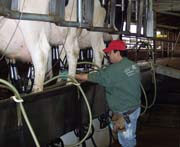
For George Crave and his brothers, it means maintaining a good relationship with about 600 Holsteins. The Craves and their families operate Crave Brothers Farms, and Crave Brothers Farmstead Cheese, LLC.
The former is a successful dairy farm operation, and a large one by Wisconsin standards. It's also a business that the brothers developed themselves, although they did grow up on a Wisconsin farm less than an hour away near Beloit. Four years ago, looking to add more value to their product and new dimensions to their lives, the Craves added a cheesemaking operation.
Across the street from the farm's milk barn, they built a brand new, high-quality cheese plant. Raw milk is transported to the cheese plant through a pipe that runs under the road. An hour or so after leaving the cow, the milk is being processed and pumped into the vats.
Could the Craves have found a simpler way to add value to their product than building a plant and launching a second business? Sure, and they thought about it.
"We looked at going organic," says George Crave, president. "We gave it serious consideration, but it's a three-year process to get the feed certified. (Crave Brothers grows much of its own feed on the flat, rich ground of its 1,500-acre farm in the southeastern part of the state.) And it's another year for the cows."
And, while the market for organic milk is growing, so is the market for specialty cheese, and it's a market that, for the Craves, offered more of a creative challenge. After opening the plant in 2001, and hiring a cheesemaker, Crave began taking courses himself and recently became a certified cheesemaker.
"We realized we could continue to sell some of our milk and still have some available to make these extremely specialty type cheeses," he says. "I thought that would be the fun part."
And fun it has been, with his wife Debbie working full time to market and promote the cheese (she works closely with the Wisconsin Milk Marketing Board and exhibits at trade shows), George has concentrated on learning more about cheese and the cheese making craft. Last year the couple traveled to Europe in part to research cheese styles, and last year too, Crave Brothers added an aged, washed rind cheese, Les Frères, to its line of products. The name, which means "the brothers" when translated from French to English, was chosen to reflect the family's Irish and French roots.

Small but modern
The Crave Brothers farm operation is modern and efficient. So when the Craves set out to build a cheese plant they wanted a modern, efficient cheese plant, says George Crave."A lot of the really small plants are very basic," he says. "People walk into our facility and they say ‘Wow, you've built a real cheese factory here.'"
That "real factory" designation comes from the use of modern process equipment, stainless steel cheesemaking equipment, and building components designed with dairy-plant sanitation practices in mind.
As for the size, well, with capacity to produce about 2 million lbs of cheese a year, the plant is tiny in comparison to giant plants in Europe and California which can produce that much cheese in a couple days. But it's still a substantial operation compared to some of the smallest artisan cheese facilities in the upper Midwest, and on the coasts.
On the farm side of the operation, raw milk is refrigerated at 37° F in a cold storage tank as soon as the cows are milked. A stainless steel elbow connects the tank to the underground pipe when cheese is being made. Mark Crave, who works on the farm operation jokes that the piece of steel is the raw milk transportation department.
In reality, the farm still sells much of its milk to other users.
Once the milk crosses under the road it goes first to a processing room in the back of the plant. A Westfalia separator is used to separate the cream from the skim. An AGC Proflow heat exchanger then pasteurizes the separated milk.
"We pasteurize all of our milk," Crave says as he enters the small room. "Some of the really little operations out there use raw milk, but ours is all pasteurized."
The Crave Brothers product line allows for the use of all the separated milk components. Cheese makes are scheduled so that cream and milk can be used directly after pasteurization rather than being stored.
"We use the sweet cream to make the mascarpone, and our fresh mozzarella or part-skim mozzarella and oaxaca are made using the skim milk." Oaxaca is a Hispanic cheese similar to mozzarella, that's pronounced wa-haka.
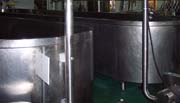
From the heat exchanger milk is pumped into one of two 25,000 lb vats outfitted with Damrow agitators. The vats are about 30 years old and were built by Kraft Foods.
"Kraft used to build its own equipment, and they made it very durable," Crave says. "These things are built like tanks."
Much of the equipment in the plant was rebuilt or refurbished by a custom fabricator, International Machinery Exchange in nearby Deerfield, Wis., Crave says.
"They just did a fantastic job. It was real convenient for us that they are right here and they worked with us throughout the process," he says.
Once the vats are filled milk is brought up to temperature and cultures are added.
"Curd formation and cutting is done in the vats," Crave explains, "and then (for mozzarella-type cheeses) the curd is pumped over to the stretcher cooker." Set times and cooking methods vary depending on the product.
The stretcher cooker equipment was custom fabricated by Winning Designs, Cottage Grove, Wis. A mozzarella molder imported from Italy features a number of interchangeable molds which allows for the production of different sized ropes and balls.
Hands-on cheesemaking
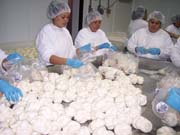
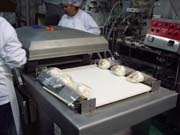
Once the cheese is formed and cooled in a cold water bath it is transferred to one of several large portable bins for brining. The bins are moved to a second room adjacent to the make room. About the size of a small restaurant kitchen, this is where the hands-on part of the cheesemaking is done and where the packaging takes place.On the day Dairy Foods visited the facility, more than a dozen plant employees were engaged in forming the ropes into braids for the Oaxaca product. It's a labor-intensive process. Next, the braids, which have been slipped into plastic bags are vacuum sealed with one of two double-chambered sealing machines from Sipromac. About a dozen pieces are placed on the sealer by hand and the sealing mantle is then locked down into place and heat and vacuum are applied to achieve the seal.
Once the packages are sealed they are hand packed into corrugated cases.
Mascarpone is made in one of the same two vats. It's an acidified product, and after the curd is formed it is hot-filled. One of two cup fillers is used to fill packages ranging in size from 8 oz to 5 lbs. One larger food service package, a 40 lb pail, is hand packed.
Les Frères, the company's latest offering, is a 2.5 lb wheel made with particular cultures that help develop a fermented rind. It is aged for up to a month in an aging cellar at the plant, then wrapped in a foil and paper package.
Les Frères is sold in random weight pieces. Soon Crave Brothers will introduce an 8 oz. Petite Frères to be sold whole.
Made to order
All the cheese at Crave Brothers is made to order."You know where the cheese is going on the day that it's made," Crave says. "We can store here for about a week."
The plant operates five days a week, with production beginning early in the morning. Packaging personnel rotate in for what is described as a "one and a half shift day."
The entire day's operation including maintenance takes about 15 hours. There are 18 to 20 people employed to operate the plant. It's a 7,000 sq foot building situated on a few acres of the farm.
The Crave Brothers Farmstead Classics line is marketed coast-to-coast through Roth Käse in Monroe. Private
label products are sold through a number of distributors
and marketers.
Sidebar: The Cheeses
The Crave Brothers line of cheeses began with fresh cheese products and has been expanded to include four main products. The descriptions below are from the company. The awards listed are the most recent and/or most prominent, but do not represent a complete list.Farmstead Classics Mascarpone is a fresh, sweet cheese used mainly in desserts. It can be spread on wafer cookies, layered with raspberries or even mixed with whipped cream for use as a dip. It comes in 8 oz. and 16 oz. retails sizes and a 5 lb foodservice tub. Awards: Silver Medal, Mascarpone category, 2005 World Cheese Awards, London. Second place and top scoring Mascarpone, Mascarpone category, 2004 American Cheese Society.
Farmstead Classics Fresh Mozzarella is a fresh, milky cheese great for salads and appetizers. It can be served with fresh tomatoes, drizzled with olive oil and sprinkled with fresh basil. The cheese is packed in water to keep it fresh. It comes in retail and foodservice containers of ciliegine (cherry size), bocconcini (ball size), ovoline (egg size), 8 oz balls, and 1lb logs. Awards: First Place for foodservice fresh mozzarella at the 2005 United States cheese championship, Milwaukee. Second place and top scoring fresh mozzarella, fresh mozzarella category, 2004 American Cheese Society.
Farmstead Cheese Farmer's Rope-Part-Skim Mozzarella is a farm fresh handmade deli string cheese. It is shaped like a rope and it forms "strings" when pulled apart. It comes in 12 oz., 2 lb, and 3 lb retail sizes. Awards: First place, string cheese category, 2004 Wisconsin State Fair. First Place, mozzarella category 2004 American Cheese Society.
Farmstead Classics Les Frères (pronounced lay frair) was developed with care to reflect the Crave Brothers' Irish-French heritage. It is a rich rind-washed cheese with an earthy, fruity flavor. It should be served with fruits and breads, paired with wine or included in a cheese course. Les Frères is sold in a 2 lb wheel, and an 8 oz Petite Frères has just been introduced. Awards: Silver Medal, 2005 World Cheese Awards, London. First place, semi-soft cheese category, 2003 World Dairy Expo Championship. Second place, semi-soft cheese category, 2004 Wisconsin State Fair.
Sidebar: Suppliers
Airlite Plastics Co. - www.airliteplastics.com
AGC - www.agcengineering.com
Chr. Hansen - www.chr-hansen.com
Danisco - www.danisco.com
International Machinery Exchange -
www.imexchange.com
Sipromac - www.sipromac.com
Westfalia Separators - www.westfalia-separator.com
Looking for a reprint of this article?
From high-res PDFs to custom plaques, order your copy today!