Ratcheting Up Breyers Yogurt
The
dairy plant located in this tiny town north of the Adirondack Mountains is
focused almost exclusively on manufacturing yogurt and cottage cheese. But an
MVR evaporator system also produces a significant amount of concentrated fluid
milk products. These include traditional skim condense and blends of milk
solids designed to meet customer needs.
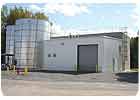
NORTH LAWRENCE, N.Y.-The dairy plant located in this tiny town north of the Adirondack Mountains is focused almost exclusively on manufacturing yogurt and cottage cheese. But an MVR evaporator system also produces a significant amount of concentrated fluid milk products. These include traditional skim condense and blends of milk solids designed to meet customer needs.
Of interest is the fact that the evaporation system was once used to condense dairy by-products for land application. It was re-commissioned for product use after the plant installed a wastewater pre-treatment system that captures methane for use in firing the plant’s boilers. The pre-treatment system, designed and operated by Ecovation, Victor, N.Y., not only eliminates all but a fraction of the land application of waste material, it also has allowed the plant to reduce its use of fuel oil by approximately 25%. It uses Ecovation’s patented Mobilized Film Technology (MFT).
Doug Dornbier, v.p. of dairy operations for the newly created Breyers Yogurt Co., has managed the plant at North Lawrence since 2001. Dornbier was excited to illustrate the impact of the new wastewater system when Dairy Foods visited the facility recently.
“We separate the raw material resources into a four Fs pyramid to demonstrate where our organic material ultimately ends up, and those are food, fuel, feed and fertilizer,” Dornbier said while discussing the new system at the plant. “The food use options are at the top of the pyramid which represents the highest value and resource utilization. The use of disposal of raw materials as a form of fertilizer is at the bottom of our pyramid and represents the lowest value or additional costs to our business. Our operational goals are to utilize as much as possible into food or saleable units and we want to keep as little as possible from going into less valuable outputs like feed and fertilizer.” Waste product which had fed pigs and cows now helps feed microbes in the methane reactor, Dornbier explains.
The state-of-the-art wastewater facility is the latest chapter of this storied facility. Located on a 100+ year-old site that once housed a milk evaporation and canning plant, the current facility came to life as the Beatles came to America in 1964. The plant locale is less than 30 minutes from the Saint Lawrence Seaway crossing at the Canadian town of Cornwall. In the decades since the modern plant was built, it served as a yogurt, sour cream and cottage cheese facility, and for most of that time it was owned by Kraft Foods. A major multi-phased renovation and expansion began in the late 1980s and was completed in 1993. In 2005 Kraft sold the plant to CoolBrands International, and earlier this year it was acquired by Healthy Food Holdings, a new company created through a partnership of a private brand acquisition group and organic dairy pioneer Chuck Marcy.
With seven production lines, producing up to 150 million lbs of product a year, North Lawrence employs more than 150 people, and continues to play an important role in both the local community and in the North American dairy industry.
The eight-pond, 60-acre system was sufficient, but had some limitations in that it was prone to seasonal overloads, odor issues and high operating costs. Additionally, some of the more high-strength waste streams had to be segregated for land application or animal feed use, but those streams are actually the preferred kinds of material for feeding the methogenic bacteria in the new anaerobic pre-treatment facility. This includes CIP first rinse, acid whey, rinse water, line changeovers and yogurt waste.
Due to its rural setting, the plant relies heavily on No. 6 fuel oil and electricity as its main energy sources. The biogas generated by the pre-treatment facility is expected to replace nearly 250,000 gallons of fuel oil each year-about 25% of plant’s total usage. That means a reduction in fuel costs and a reduction in fossil fuel emissions for North Lawrence.
“With a reduction in the level of material being introduced into the aerobic ponds we have now eliminated a bottleneck, so we will be able to increase our production at the plant and grow our business,” Dornbier says. The MFT system has provided options that support the environmental stewardship roles of Breyers Yogurt Company.”
At North Lawrence, Ecovation’s MFT system utilizes an enclosed, rectangular shaped reactor made of poured concrete. The waste stream is introduced through a series of manifolds that place it at different levels and in different areas throughout the reactor.
Ecovation says a combination of three features inherent to the MFT distinguish it from competing technologies:
Ecovation developed the project under a design-build-finance agreement, and assisted Breyers in attaining a $500,000 USDA Renewable Energy Grant. Under a separate 20-year agreement, Ecovation will assume responsibility for operation of the entire wastewater treatment system.
The Breyers plant was the one of the first dairy plant projects for Ecovation, but it has since inked deals for others in New York.
“We will have several new installations completed in 2007,” says Diane Creel, CEO of Ecovation. “Once all are fully operational, Ecovation will produce over 2.5 million therms of renewable energy in New York State alone.”
While all the cottage cheese is made for a national customer, all the yogurt is Breyers, which Dornbier describes as an “All-American brand.” While the ownership has changed twice in the last two years, the consistency of producing that brand has been a stabilizing force in the plant.
“The operational team has a very proud and dedicated workforce,” Dornbier says. “Any time the ownership changes problems and concerns can surface, but we have been able to hold some continuity in the work force across all levels, and build a solid management team.
“Among the employee base at the facility we feel we have a great product in the Breyers brand, and the line of products we produce. There is a certain dedication to the brand and a pride of ownership in the brand that everyone takes very seriously.”
Milk for the plant is procured through two major cooperatives, DMS and Agrimark from local farms in New York. The North Lawrence operations play a significant part in the local economy.
Milk arrives in tankers that are offloaded through one of three drive-through receiving bays. Once quality tests are done and the milk is accepted it is pumped to one of five raw milk silos. The plant has a total raw milk storage capacity of about 250,000 gals.
The milk is separated and recombined to the proper fat levels for the different products before pasteurization. Milk components are stored in refrigerated silos before being called up for yogurt batching or sent to the make room for cottage cheese. The cheesemaking process is a typical setup using open Stoelting cheese vats.
Yogurt is made with batch set process in which milk is initially blended with sweeteners and stabilizers and dry milk solids. That mix is then pasteurized, inoculated with cultures and held in tanks at fermentation temperatures until the white mass has formed. Breyers Light line was recently reformulated to include probiotic cultures, and those cultures are added at this point for those batches.
Once the white mass is formed, the product is chilled below 40° F and stored in silos for blending. When a production run is started, white mass is pulled from different tanks and blended for consistency.
Among the five yogurt fillers, four are Osgood cup fillers set up to run 6- or 8-oz preformed cups. An Erca/Formseal form/fill/seal unit currently runs four packs, six packs or eight packs with 4 oz servings that can contain multiple flavors.
“We do some fruit-on-the-bottom products and for those, of course the fruit is added in one stage and the white mass is added on top,” Dornbier says. “For the blended products the fruit is added with controlled metering in line just before the filler.”
The Osgood machines are linear fillers that fill product in rows of six cups. Once the cups are full, a foil seal is applied and they move to the next unit of operations, which is automated case packaging and palletizing.
On the form/fill/seal the cups are formed from a flat sheet of plastic that is vacuumed into cavities in a conveyor running through the machine. After the cups are formed, they are conveyed beneath fill nozzles where the product is dispensed. A continuous laminated film of plastic and of aluminized foil lidding is heat sealed to the flanges of the cups. The sheets are then cut into groupings of four, six or eight.
The Erca/Formseal unit can fill multipacks with all one flavor, two different flavors, or four different flavors. The fillers are also equipped to fill Breyers Crème Saver flavors with in-house developed patented fill technology.
Inside the filling rooms, product is pulled regularly for testing as it leaves the fillers. Operators are engaged with Quality testing to insure customer satisfaction. Additional samples are also sent to the on-site lab. Beyond the filling room, packages go through a Mettler-Toledo checkweigher and are code dated before being sent to wrap-around case packers. Samples are pulled from the line and pressure tested for leak detection. Each line has a dedicated caser which puts the cups or multipacks into corrugated shippers. Product specific information is applied to each case, and they are sent to line-dedicated automated Columbia palletizers.
Coordinated efforts across the line have led to performance efficiencies that ensure quality products ready for delivery.
Product is ultimately shipped by a dedicated fleet or third party carrier to customers across the country. The Breyers brand products are distributed primarily along the Atlantic Coast, but under the new ownership, Breyers, and the YoCrunch brand (also now under the Breyers Yogurt Co. umbrella) will enter wider distribution (see related story).
The brands produced at North Lawrence are Breyers Smooth and Creamy, Breyers Creme Savers, Breyers Light With Probiotics, and Breyers All Natural Fruit on the Bottom. That is unlikely to change, as the YoCrunch brand, which requires a special packaging process for their compartmentalized toppings, will continue to be made in Connecticut.
Meanwhile, the 150-plus employees at North Lawrence will continue making quality products with a value-added emphasis, Dornbier says. Recently the plant held a recognition event for all the members of one particular local family that has worked more than 1 million hours at the plant across three generations. There were more than 50 people involved. North Lawrence has a long history of providing employment for many families in this rural Upstate community. The work force has a commitment of quality of work that is reflected in the Breyers brand, Dornbier said.
The plant contributes millions of dollars to the local economy annually through its business activities, and there is a strong community outreach program which includes an educational partnership with Clarkson University and other local schools, support for the local FFA chapter and donations to local organizations, food pantries, emergency shelters and civic groups.
Alcan Packaging
Alpha Laval
APV
Atlantic Gelatin
Brenton
Cargill
Chr. Hansen
Columbia Palletizers
Dairy Market Services
Fabri-Kal
Fristam Pumps
Leprino Foods
(WPC and whey powder)
MVI Technology
National Starch
Nordson
Osgood
Ross Systems
Stoelting (vats)
Sweet Ovations
SWF
Westfalia Separator
Weyerhaeuser
Winn Pack
Healthy Food Holdings LLC, Boulder, Colo., is a portfolio company of private equity firm Catterton Partners, Greenwich, Conn., and it is operated by CEO Chuck Marcy, who founded Horizon Organic. Marcy grew Horizon Organic into a $250 million company, creating the No. 1 brand of organic milk in the U.S. in the years leading up to Horizon’s acquisition by Dean Foods.
Healthy Food Holdings was created in 2005 to facilitate the acquisition of YoFarm Co., Naugatuck, Conn. Late last year, Healthy Food acquired Van’s International Foods, Inc., the maker and marketer of the leading brand of all-natural and organic frozen waffles.
“Our mission is to provide healthy alternatives to conventional foods,” Marcy told Dairy Foods in January. “Yogurt seemed like a great category to get involved with.”
Both YoFarm’s YoCrunch brand and the Breyers brands are centered primarily on the Atlantic Coast, but their new parent company will work to move them into other markets through mass national club stores, mass merchandisers and grocery chains.
Doug Dornbier, v.p. of operations for Breyers Yogurt Co. says the new owners have the right vision and see the opportunities that will help the brands grow.
“They bring definite resources to the business,” Dornbier says. “ And they certainly have experience in cultured products and dairy. I think our product lines and our operations at YoFarm and Breyers complement one another. And I think we will be able to leverage the resources on both sides and build on each others successes.”
A new pre-treatment facility provides the North Lawrence
plant with environmental advantages and a renewable energy source.
NORTH LAWRENCE, N.Y.-The dairy plant located in this tiny town north of the Adirondack Mountains is focused almost exclusively on manufacturing yogurt and cottage cheese. But an MVR evaporator system also produces a significant amount of concentrated fluid milk products. These include traditional skim condense and blends of milk solids designed to meet customer needs.
Of interest is the fact that the evaporation system was once used to condense dairy by-products for land application. It was re-commissioned for product use after the plant installed a wastewater pre-treatment system that captures methane for use in firing the plant’s boilers. The pre-treatment system, designed and operated by Ecovation, Victor, N.Y., not only eliminates all but a fraction of the land application of waste material, it also has allowed the plant to reduce its use of fuel oil by approximately 25%. It uses Ecovation’s patented Mobilized Film Technology (MFT).
Doug Dornbier, v.p. of dairy operations for the newly created Breyers Yogurt Co., has managed the plant at North Lawrence since 2001. Dornbier was excited to illustrate the impact of the new wastewater system when Dairy Foods visited the facility recently.
“We separate the raw material resources into a four Fs pyramid to demonstrate where our organic material ultimately ends up, and those are food, fuel, feed and fertilizer,” Dornbier said while discussing the new system at the plant. “The food use options are at the top of the pyramid which represents the highest value and resource utilization. The use of disposal of raw materials as a form of fertilizer is at the bottom of our pyramid and represents the lowest value or additional costs to our business. Our operational goals are to utilize as much as possible into food or saleable units and we want to keep as little as possible from going into less valuable outputs like feed and fertilizer.” Waste product which had fed pigs and cows now helps feed microbes in the methane reactor, Dornbier explains.
The state-of-the-art wastewater facility is the latest chapter of this storied facility. Located on a 100+ year-old site that once housed a milk evaporation and canning plant, the current facility came to life as the Beatles came to America in 1964. The plant locale is less than 30 minutes from the Saint Lawrence Seaway crossing at the Canadian town of Cornwall. In the decades since the modern plant was built, it served as a yogurt, sour cream and cottage cheese facility, and for most of that time it was owned by Kraft Foods. A major multi-phased renovation and expansion began in the late 1980s and was completed in 1993. In 2005 Kraft sold the plant to CoolBrands International, and earlier this year it was acquired by Healthy Food Holdings, a new company created through a partnership of a private brand acquisition group and organic dairy pioneer Chuck Marcy.
With seven production lines, producing up to 150 million lbs of product a year, North Lawrence employs more than 150 people, and continues to play an important role in both the local community and in the North American dairy industry.
Five of the plant’s seven lines are dedicated to
yogurt and two to cottage cheese.
Water and whey
The North Lawrence facility is built on a 286-acre site adjacent to a tributary known as Deer River. In its early days, the plant, like most of the era sent wastewater directly into that river, but starting in the early 1960s a series of aerobic lagoons were used for wastewater treatment.The eight-pond, 60-acre system was sufficient, but had some limitations in that it was prone to seasonal overloads, odor issues and high operating costs. Additionally, some of the more high-strength waste streams had to be segregated for land application or animal feed use, but those streams are actually the preferred kinds of material for feeding the methogenic bacteria in the new anaerobic pre-treatment facility. This includes CIP first rinse, acid whey, rinse water, line changeovers and yogurt waste.
Due to its rural setting, the plant relies heavily on No. 6 fuel oil and electricity as its main energy sources. The biogas generated by the pre-treatment facility is expected to replace nearly 250,000 gallons of fuel oil each year-about 25% of plant’s total usage. That means a reduction in fuel costs and a reduction in fossil fuel emissions for North Lawrence.
“With a reduction in the level of material being introduced into the aerobic ponds we have now eliminated a bottleneck, so we will be able to increase our production at the plant and grow our business,” Dornbier says. The MFT system has provided options that support the environmental stewardship roles of Breyers Yogurt Company.”
At North Lawrence, Ecovation’s MFT system utilizes an enclosed, rectangular shaped reactor made of poured concrete. The waste stream is introduced through a series of manifolds that place it at different levels and in different areas throughout the reactor.
Ecovation says a combination of three features inherent to the MFT distinguish it from competing technologies:
- Immobilization uses a heavy, small diameter inert particle upon which the bacteria can attach in a thin film. The result is tremendous populations in compact amounts of space. The high density of microorganisms (10 to 50 times higher than in conventional aerobic facilities) in the reactor means that an MFT anaerobic system can treat the same mass of organic compounds as a much larger aerobic plant.
- Integration is the method by which the MFT ensures complete assimilation between the organics in the wastewater and the attached biomass. It is achieved through hydraulic control which successfully corresponds the upflow velocity of the wastewater to the settling rate of the biomass. As an added advantage, given the specific gravity of the heavy particle to which the biomass is attached, it will always settle while suspended solids will migrate through the biomass and be continuously wasted in the effluent.
- Plug plow is approximated in the MFT to ensure a first-in, first-out method of treatment. It allows for maximum organic reduction at minimum hydraulic retention times (HRT) and results in the lowest possible effluent concentrations from anaerobic treatment.
Ecovation developed the project under a design-build-finance agreement, and assisted Breyers in attaining a $500,000 USDA Renewable Energy Grant. Under a separate 20-year agreement, Ecovation will assume responsibility for operation of the entire wastewater treatment system.
The Breyers plant was the one of the first dairy plant projects for Ecovation, but it has since inked deals for others in New York.
“We will have several new installations completed in 2007,” says Diane Creel, CEO of Ecovation. “Once all are fully operational, Ecovation will produce over 2.5 million therms of renewable energy in New York State alone.”
State-of-the art production procedures include
pressure testing for leak detection.
Yogurt is king
Yogurt was once the newcomer at the North Lawrence plant, but five of the seven production lines are currently dedicated to yogurt and two are used to produce cottage cheese for a major national marketer.While all the cottage cheese is made for a national customer, all the yogurt is Breyers, which Dornbier describes as an “All-American brand.” While the ownership has changed twice in the last two years, the consistency of producing that brand has been a stabilizing force in the plant.
“The operational team has a very proud and dedicated workforce,” Dornbier says. “Any time the ownership changes problems and concerns can surface, but we have been able to hold some continuity in the work force across all levels, and build a solid management team.
“Among the employee base at the facility we feel we have a great product in the Breyers brand, and the line of products we produce. There is a certain dedication to the brand and a pride of ownership in the brand that everyone takes very seriously.”
Milk for the plant is procured through two major cooperatives, DMS and Agrimark from local farms in New York. The North Lawrence operations play a significant part in the local economy.
Milk arrives in tankers that are offloaded through one of three drive-through receiving bays. Once quality tests are done and the milk is accepted it is pumped to one of five raw milk silos. The plant has a total raw milk storage capacity of about 250,000 gals.
The milk is separated and recombined to the proper fat levels for the different products before pasteurization. Milk components are stored in refrigerated silos before being called up for yogurt batching or sent to the make room for cottage cheese. The cheesemaking process is a typical setup using open Stoelting cheese vats.
Yogurt is made with batch set process in which milk is initially blended with sweeteners and stabilizers and dry milk solids. That mix is then pasteurized, inoculated with cultures and held in tanks at fermentation temperatures until the white mass has formed. Breyers Light line was recently reformulated to include probiotic cultures, and those cultures are added at this point for those batches.
Once the white mass is formed, the product is chilled below 40° F and stored in silos for blending. When a production run is started, white mass is pulled from different tanks and blended for consistency.
Among the five yogurt fillers, four are Osgood cup fillers set up to run 6- or 8-oz preformed cups. An Erca/Formseal form/fill/seal unit currently runs four packs, six packs or eight packs with 4 oz servings that can contain multiple flavors.
“We do some fruit-on-the-bottom products and for those, of course the fruit is added in one stage and the white mass is added on top,” Dornbier says. “For the blended products the fruit is added with controlled metering in line just before the filler.”
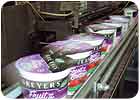
The Osgood machines are linear fillers that fill product in rows of six cups. Once the cups are full, a foil seal is applied and they move to the next unit of operations, which is automated case packaging and palletizing.
On the form/fill/seal the cups are formed from a flat sheet of plastic that is vacuumed into cavities in a conveyor running through the machine. After the cups are formed, they are conveyed beneath fill nozzles where the product is dispensed. A continuous laminated film of plastic and of aluminized foil lidding is heat sealed to the flanges of the cups. The sheets are then cut into groupings of four, six or eight.
The Erca/Formseal unit can fill multipacks with all one flavor, two different flavors, or four different flavors. The fillers are also equipped to fill Breyers Crème Saver flavors with in-house developed patented fill technology.
Inside the filling rooms, product is pulled regularly for testing as it leaves the fillers. Operators are engaged with Quality testing to insure customer satisfaction. Additional samples are also sent to the on-site lab. Beyond the filling room, packages go through a Mettler-Toledo checkweigher and are code dated before being sent to wrap-around case packers. Samples are pulled from the line and pressure tested for leak detection. Each line has a dedicated caser which puts the cups or multipacks into corrugated shippers. Product specific information is applied to each case, and they are sent to line-dedicated automated Columbia palletizers.
Coordinated efforts across the line have led to performance efficiencies that ensure quality products ready for delivery.
Storage and distribution
Pallets are also labeled with bar codes, and data is entered into a warehouse management system to manage first-in first-out distribution. The system manages a series of rollback pallet racks that holds up to 3,500 pallets. Product is moved by forklift and conveyors throughout the cooler, and ultimately to one of four loadout docks. The loadout, like the rest of the plant, operates 24 hours a day, six-plus days a week.Product is ultimately shipped by a dedicated fleet or third party carrier to customers across the country. The Breyers brand products are distributed primarily along the Atlantic Coast, but under the new ownership, Breyers, and the YoCrunch brand (also now under the Breyers Yogurt Co. umbrella) will enter wider distribution (see related story).
The brands produced at North Lawrence are Breyers Smooth and Creamy, Breyers Creme Savers, Breyers Light With Probiotics, and Breyers All Natural Fruit on the Bottom. That is unlikely to change, as the YoCrunch brand, which requires a special packaging process for their compartmentalized toppings, will continue to be made in Connecticut.
Meanwhile, the 150-plus employees at North Lawrence will continue making quality products with a value-added emphasis, Dornbier says. Recently the plant held a recognition event for all the members of one particular local family that has worked more than 1 million hours at the plant across three generations. There were more than 50 people involved. North Lawrence has a long history of providing employment for many families in this rural Upstate community. The work force has a commitment of quality of work that is reflected in the Breyers brand, Dornbier said.
The plant contributes millions of dollars to the local economy annually through its business activities, and there is a strong community outreach program which includes an educational partnership with Clarkson University and other local schools, support for the local FFA chapter and donations to local organizations, food pantries, emergency shelters and civic groups.
Breyers Yogurt Co. Vendors
Agri-MarkAlcan Packaging
Alpha Laval
APV
Atlantic Gelatin
Brenton
Cargill
Chr. Hansen
Columbia Palletizers
Dairy Market Services
Fabri-Kal
Fristam Pumps
Leprino Foods
(WPC and whey powder)
MVI Technology
National Starch
Nordson
Osgood
Ross Systems
Stoelting (vats)
Sweet Ovations
SWF
Westfalia Separator
Weyerhaeuser
Winn Pack
Sidebar: New Parent Company Sees Opportunities
The latest owners of the North Lawrence, N.Y. dairy facility now known as the Breyers Yogurt Plant also own an organic waffle company, but they are no strangers to the yogurt and dairy business.Healthy Food Holdings LLC, Boulder, Colo., is a portfolio company of private equity firm Catterton Partners, Greenwich, Conn., and it is operated by CEO Chuck Marcy, who founded Horizon Organic. Marcy grew Horizon Organic into a $250 million company, creating the No. 1 brand of organic milk in the U.S. in the years leading up to Horizon’s acquisition by Dean Foods.
Healthy Food Holdings was created in 2005 to facilitate the acquisition of YoFarm Co., Naugatuck, Conn. Late last year, Healthy Food acquired Van’s International Foods, Inc., the maker and marketer of the leading brand of all-natural and organic frozen waffles.
“Our mission is to provide healthy alternatives to conventional foods,” Marcy told Dairy Foods in January. “Yogurt seemed like a great category to get involved with.”
Both YoFarm’s YoCrunch brand and the Breyers brands are centered primarily on the Atlantic Coast, but their new parent company will work to move them into other markets through mass national club stores, mass merchandisers and grocery chains.
Doug Dornbier, v.p. of operations for Breyers Yogurt Co. says the new owners have the right vision and see the opportunities that will help the brands grow.
“They bring definite resources to the business,” Dornbier says. “ And they certainly have experience in cultured products and dairy. I think our product lines and our operations at YoFarm and Breyers complement one another. And I think we will be able to leverage the resources on both sides and build on each others successes.”
Looking for a reprint of this article?
From high-res PDFs to custom plaques, order your copy today!